
Key Takeaways
- Most operational bottlenecks go undetected for weeks because manual monitoring can't keep up with data volume
- AI analyses patterns across systems to identify slowdowns, capacity issues, and process failures automatically
- Proactive bottleneck alerts reduce average resolution time from weeks to hours
- Cross-functional AI analysis reveals bottlenecks that exist between departments, not just within them
The Hidden Cost of Operational Bottlenecks
Operational bottlenecks are the silent profit killers in every business. A slow approval process delays projects by weeks. A manual data entry step introduces errors that cascade through the system. A resource shortage in one team blocks progress across three others.
The real problem isn't that bottlenecks exist - it's that they go undetected. Most businesses discover bottlenecks through complaints, missed deadlines, or declining metrics. By the time the problem is visible, it's already cost the business time, money, and customer satisfaction.
How AI Detects Bottlenecks
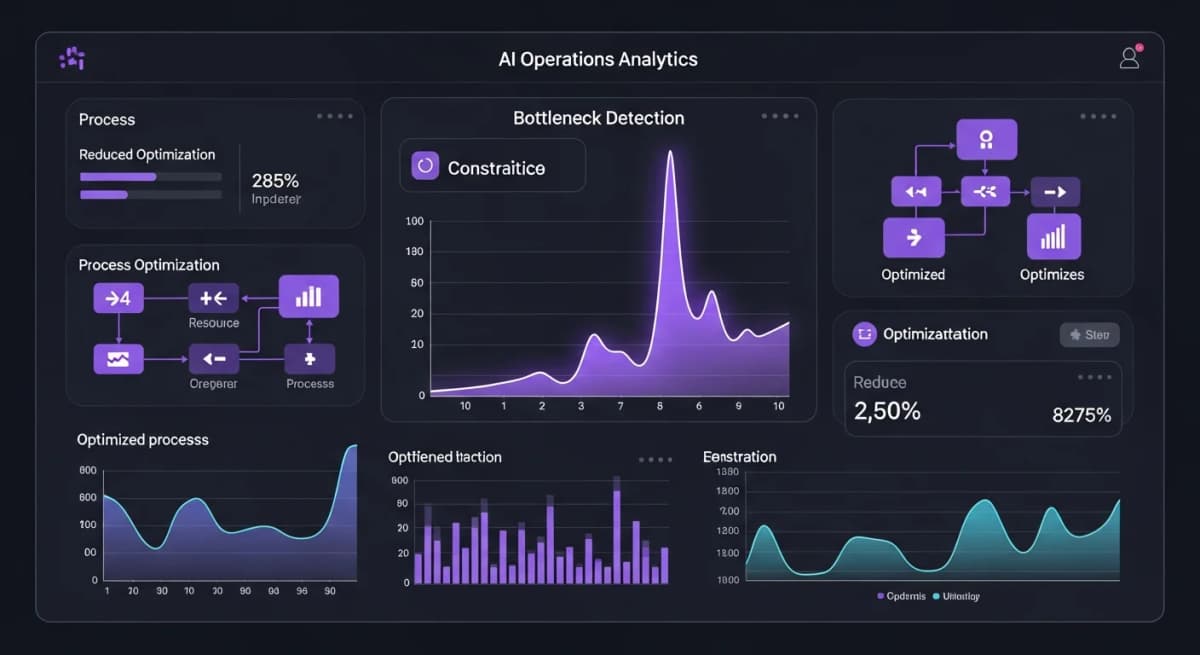
AI detects bottlenecks by analysing patterns in your operational data that humans can't see at scale.
Process timing analysis - AI tracks how long each step in a process takes and flags when any step exceeds normal duration. If your design review stage usually takes 2 days but has averaged 5 days this month, AI catches it.
Queue depth monitoring - AI monitors work queues across teams. When a queue grows faster than it's being processed, that's a bottleneck forming.
Resource utilisation - AI analyses who's overloaded and who has capacity. Bottlenecks often form because work is unevenly distributed.
Cross-system correlation - AI connects data from multiple systems to identify bottlenecks that span departments. A delay in procurement might cause a bottleneck in production - AI sees the connection.
From Reactive to Proactive Operations
Without AI, operations management is inherently reactive. You respond to problems after they've already impacted the business.
With AI monitoring, you shift to proactive operations:
Early warning alerts - "Lead response time has increased 40% this week. If this trend continues, you'll miss your monthly conversion target by 15%."
Predictive bottleneck detection - "Based on current project pipeline and team capacity, the QA team will be over capacity in 3 weeks."
Automatic root cause analysis - "Revenue growth has slowed. The primary driver is a 25% decrease in qualified leads, which correlates with a 30% reduction in ad spend last month."
Each of these insights would take hours of manual analysis. AI delivers them continuously and automatically.
Stop reading about AI reporting. Start using it.
See how Alexia.ai automates the exact workflows covered in this article.
Real-World Bottleneck Examples AI Catches
The invisible handoff delay - Between sales closing a deal and operations beginning onboarding, there's a 3-day gap where nothing happens. AI identifies the gap and flags it.
The overloaded team member - One person in finance processes 70% of all invoices. AI detects the concentration risk and recommends redistribution.
The slow approval chain - Budget approvals take an average of 8 days because they sit in someone's inbox. AI flags the delay pattern.
The seasonal capacity crunch - Every Q4, project delivery times increase 35% because the same resources are allocated to year-end reporting. AI predicts this and suggests early resource planning.
Implementing AI Bottleneck Detection
Getting started with AI bottleneck detection is simpler than most people expect:
1. Connect your operational tools (project management, CRM, financial platform) to an AI platform like Alexia.ai 2. Establish baseline metrics for your key processes 3. Set thresholds for acceptable performance 4. Let AI monitor continuously and alert you to deviations
Alexia.ai connects to 180+ business tools and automatically analyses cross-functional data to surface bottlenecks, anomalies, and optimisation opportunities. Most teams identify their first actionable bottleneck within the first week.

About the Author
Simon Lee
Co-Founder, Teamified
Simon Lee is the co-founder and CEO of Teamified, with deep expertise in cloud architecture, fintech, and SaaS platforms. He leads the vision behind Alexia.ai, designing AI-powered solutions that drive operational efficiency and business growth across global teams.
Connect on LinkedInDetect bottlenecks before they cost you
Get started free and let Alexia.ai identify operational inefficiencies across your business.