
Key Takeaways
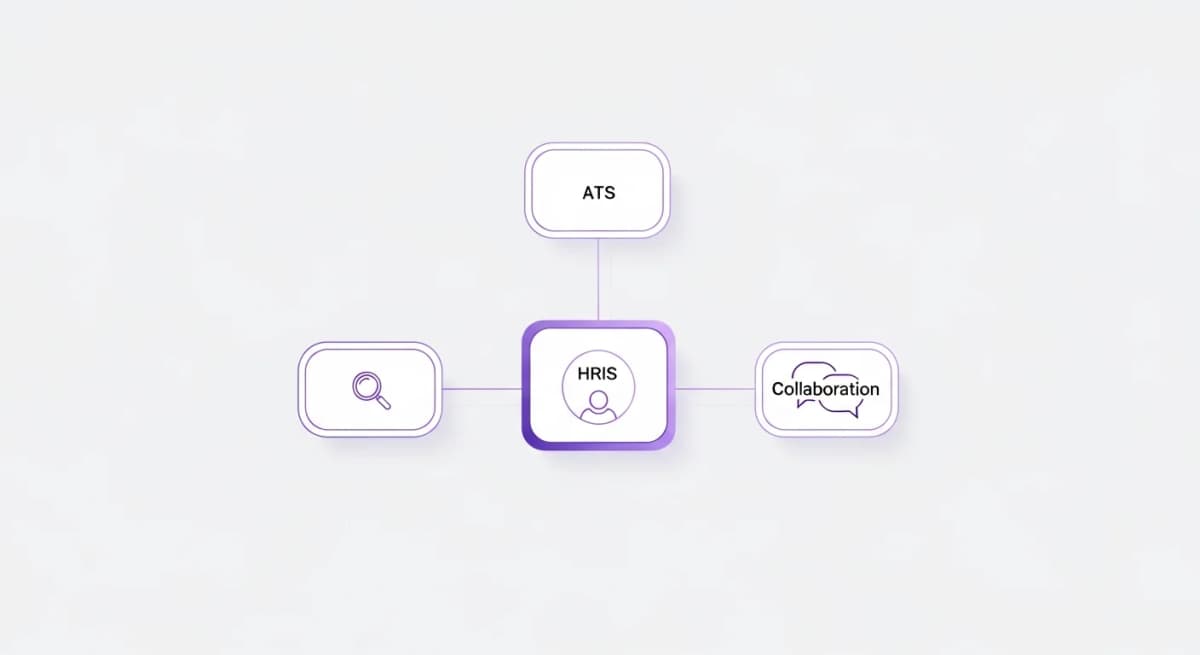
- The average company uses 12-16 separate SaaS tools for people operations - creating data silos, context switching, and unnecessary cost.
- Unified platforms that combine ATS, HRIS, and collaboration reduce total tech spend by 40-60% while improving productivity.
- The employee lifecycle - from candidate to team member to alumni - is one continuous journey that belongs in one system.
- Alexia.ai pioneered the all-in-one approach with AI-powered ATS, HRIS, and Team Connect in a single operating platform.
The Fragmentation Problem
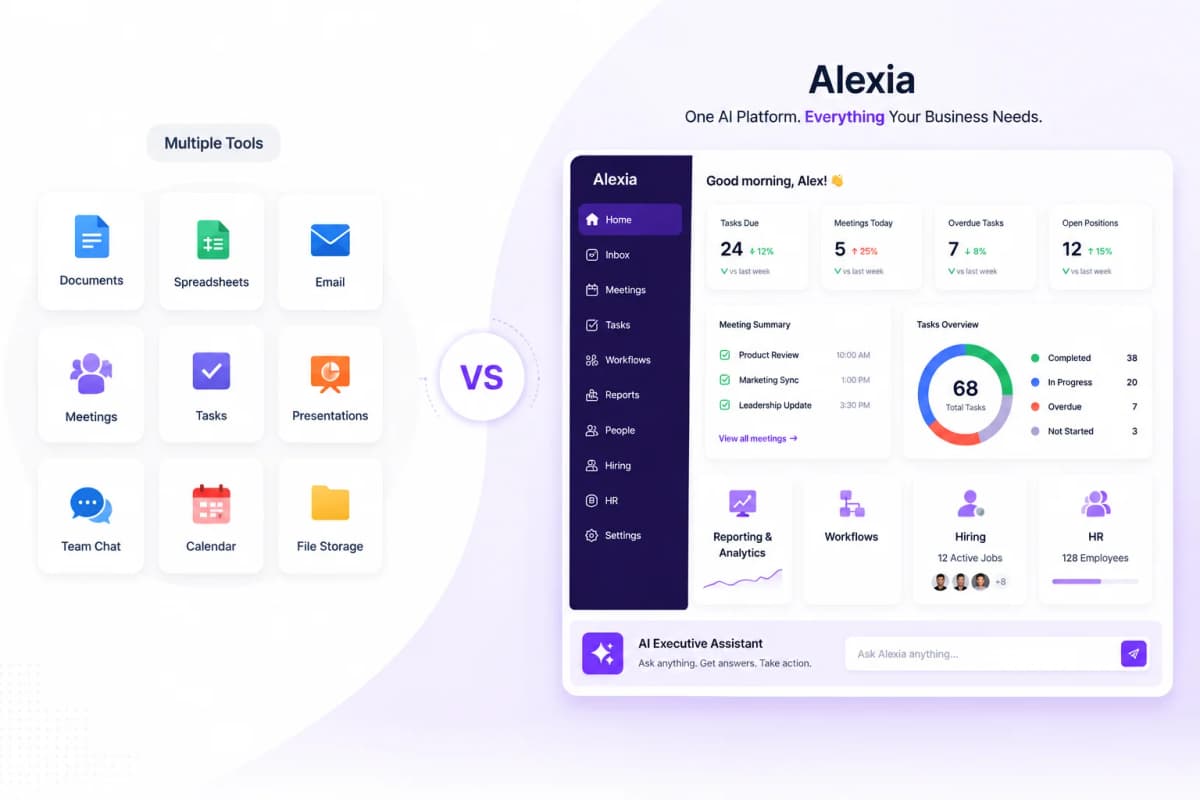
The average mid-sized company uses 12-16 separate SaaS tools for their people operations. An ATS for recruitment, an HRIS for HR management, Slack for messaging, Zoom for meetings, Google Drive for documents, Asana for tasks, and half a dozen more for specialised functions.
Each tool was selected because it was "best in class" for its category. But together, they create a fragmented mess of disconnected data, duplicated information, and constant context switching. The promise of "best of breed" has delivered worst of integration.
Why ATS, HRIS, and Collaboration Are Inseparable
Consider the employee lifecycle: a person starts as a candidate in your ATS. They become an employee in your HRIS. They interact daily through your collaboration tools. It's one continuous journey through your organisation.
But in a fragmented stack, each transition requires manual data transfer, system switches, and process handoffs. Candidate data is re-entered into the HRIS. The new hire is manually added to Slack channels. Onboarding tasks are created in yet another tool.
When ATS, HRIS, and collaboration live in one platform, the journey is seamless. A candidate accepted? Their profile automatically transitions to the HRIS. Day one? They're already in the right team channels with onboarding tasks assigned. No manual steps, no data re-entry, no gaps.
The Economics of Consolidation
The financial case for consolidation is compelling. A typical fragmented stack costs:
ATS (Greenhouse/Lever): $6,000-$15,000/year HRIS (BambooHR/Gusto): $3,600-$7,200/year Messaging (Slack): $5,250-$9,000/year Video (Zoom): $7,800-$13,200/year Integration tools: $2,000-$5,000/year Total: $24,650-$49,400/year for a 50-person company
A unified platform like Alexia.ai replaces all five with one subscription - typically saving 40-60% on total cost. But the bigger savings come from reduced administrative overhead, faster onboarding, and improved productivity from eliminating context switching.
Stop reading about AI reporting. Start using it.
See how Alexia.ai automates the exact workflows covered in this article.
The AI Advantage of Unified Data
AI systems are only as good as the data they can access. When your recruitment data lives in one system, HR data in another, and communication data in a third, AI can only see one slice of the picture at a time.
A unified platform gives AI access to the complete picture. Alexia.ai's AI can connect hiring patterns with performance outcomes, correlate communication patterns with team health, and identify organisational insights that fragmented data would never reveal.
Questions like "what characteristics of successful hires should we prioritise in our current pipeline?" require data from both ATS and HRIS. "Which teams are at attrition risk based on communication patterns?" requires HR and collaboration data. Only a unified platform can answer these questions.
The Future Is Unified
The trend is unmistakable. Every major SaaS category is experiencing consolidation as buyers reject the complexity of multi-vendor stacks. 71% of companies plan to reduce their SaaS tool count over the next two years.
The companies that consolidated early are already seeing the benefits: faster decision-making, better data quality, lower costs, and happier teams that spend less time navigating tools and more time doing meaningful work.
Alexia.ai was built from the ground up as a unified operating platform - not assembled through acquisitions or forced integrations. ATS, HRIS, Team Connect, and AI intelligence are architecturally unified, sharing the same data layer and user experience.
The question isn't whether to consolidate - it's when. And the earlier you start, the more compounding benefit you capture.

About the Author
Simon Lee
Co-Founder, Teamified
Simon Lee is the co-founder and CEO of Teamified, with deep expertise in cloud architecture, fintech, and SaaS platforms. He leads the vision behind Alexia.ai, designing AI-powered solutions that drive operational efficiency and business growth across global teams.
Connect on LinkedInStart with Alexia.ai's All-in-One Platform
ATS + HRIS + Team Connect + AI - one platform, one subscription. See the full Launch Offer.