
Key Takeaways
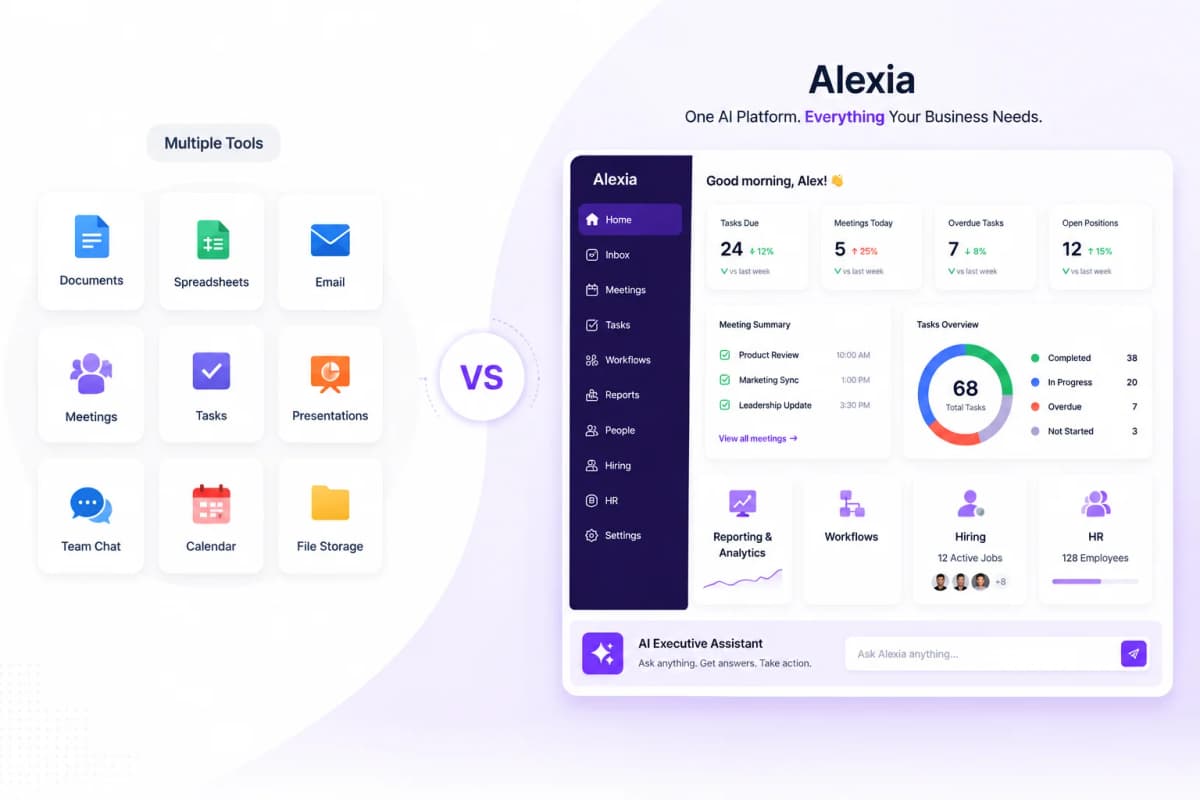
- Microsoft Copilot adds AI inside Microsoft 365 apps, while Alexia.ai is an AI-powered operating platform that runs across your entire business.
- Alexia.ai includes workflow automation, auto-refreshing reporting, an AI notetaker, and built-in ATS and HRIS that Copilot does not offer.
- Teams adopt Alexia.ai as a Microsoft Copilot alternative to consolidate several subscriptions into one platform, with 180+ integrations powered by MCPs.
- Copilot is best for organisations deeply standardised on Microsoft 365; Alexia.ai is best for teams that want one system for reporting, hiring, HR and collaboration.
Alexia.ai vs Microsoft Copilot: the short answer
Both Alexia.ai and Microsoft Copilot use AI to help your team work faster, but they solve very different problems.
Microsoft Copilot is an AI assistant that lives inside Microsoft 365 - it drafts in Word, analyses in Excel, and summarises in Teams. It is genuinely useful if your work happens inside Office.
Alexia.ai is an AI-powered operating platform. Instead of adding intelligence to a single suite of apps, it runs across your whole business - email, calendar, meetings, reporting, hiring and HR - and connects to 180+ tools regardless of which ecosystem you use. For most teams evaluating a Microsoft Copilot alternative, the real question is not "which assistant is smarter?" but "do I want AI bolted onto Office, or one platform that replaces several tools at once?"
Quick comparison: Alexia.ai vs Microsoft Copilot
Here is how the two platforms line up across the capabilities teams ask about most:
AI assistant - Both included. Alexia.ai works across your whole business; Copilot works inside Microsoft 365 apps.
Meeting notes - Alexia.ai records and summarises meetings on any platform. Copilot covers Teams meetings only.
Task management - Built into Alexia.ai with boards, goals and AI follow-up. Not included in Copilot.
Workflow automation - Native visual builder in Alexia.ai. Copilot relies on Power Automate, sold separately.
Reporting - Alexia.ai builds and auto-refreshes reports across your connected tools. Copilot is centred on your Microsoft 365 content and is not a cross-tool reporting platform.
Recruitment (ATS) and HR (HRIS) - Built into Alexia.ai. Not available in Copilot.
Team collaboration - Chat, channels and video are included with Alexia.ai. Copilot requires a separate Teams licence.
Email and calendar intelligence - Alexia.ai works across any provider. Copilot is limited to Outlook.
Why businesses look for Microsoft Copilot alternatives
Copilot is a capable assistant, but it does not solve the bigger problem most teams have: too many disconnected tools. These are the reasons we hear most often when teams go looking for an alternative.
Too many tools - Copilot is one more login on top of an already crowded stack. Teams want fewer apps, not another tab to manage.
Software sprawl - AI inside Office still leaves hiring, HR and collaboration in separate platforms that do not talk to each other.
Fragmented reporting - Your data lives in your CRM, ad platforms, finance tools and analytics. Copilot can connect to some of these, but it is built to search and answer questions rather than build and auto-refresh reports across them, so cross-tool reporting still falls to you.
Multiple subscriptions - A Copilot add-on sits alongside your messaging app, recruitment tool and HR system, each with its own renewal and admin.
No HR or hiring tools - Copilot has no ATS or HRIS, so recruitment and people management stay manual or need yet another purchase. Alexia.ai includes both as built-in modules.
Feature-by-feature: how the two platforms compare
Looking past the headline assistant, here is where the platforms diverge.
Scope of intelligence - Copilot reasons over your Microsoft 365 content. Alexia.ai reasons across your whole stack, connecting to 180+ integrations powered by MCPs so it can act on data from sales, finance, marketing and operations.
Email and calendar - Copilot enhances Outlook. Alexia.ai brings email intelligence and calendar and meeting prep to any provider you use.
Meetings - Alexia.ai's AI notetaker joins meetings on any platform, captures decisions and turns them into tasks, rather than being limited to one video tool.
Automation - Alexia.ai ships with a visual workflow builder and custom agents included, where Copilot leans on a separately licensed automation product.
Hiring and HR - This is the clearest gap. Alexia.ai includes a full recruitment pipeline and people management and HRIS. Copilot offers neither.
Collaboration - Team Connect gives Alexia.ai built-in chat, channels and video, so collaboration is part of the platform rather than a separate licence.
Replace multiple workplace apps with one AI platform
Adding Copilot keeps every other subscription in place. The bigger win for most teams is consolidation.
Alexia.ai is designed to absorb the work that a stack of point tools usually handles - messaging like Slack, video like Zoom, scheduling like Calendly, meeting notes like Fireflies, project tracking like Asana or Monday, and people tools like BambooHR or Greenhouse.
Instead of paying for and stitching together all of those, you get one AI-powered operating platform that covers chat, meetings, tasks, reporting, hiring and HR, with 180+ integrations to connect anything else you rely on. Fewer renewals, less admin, and one system your team actually opens every day.
Stop reading about AI reporting. Start using it.
See how Alexia.ai automates the exact workflows covered in this article.
Pricing and ROI: what actually matters
It is tempting to compare a per-seat licence on each side, but that misses the point.
A Copilot licence is an add-on cost layered on top of the messaging, meeting, scheduling, recruitment and HR tools you already pay for. The real number to evaluate is the total cost of your stack - and how many of those subscriptions a single platform can replace.
Because Alexia.ai bundles the assistant with automation, reporting, recruitment and HR, the return comes from consolidation rather than a lower sticker price. You can start free and only pay for AI usage as you scale, so the platform proves its value before it costs you anything. See the full breakdown on the pricing page.
Which one is right for you?
Both tools are useful. The right choice depends on how your team works.
Choose Microsoft Copilot if your work happens almost entirely in Word, Excel and PowerPoint, your organisation is fully standardised on Microsoft 365 and Teams, and you mainly want AI assistance for document co-authoring.
Choose Alexia.ai if you want to consolidate several subscriptions into one platform, you need built-in recruitment and HR, you want automation and auto-refreshing reporting across tools, or your tech stack is not locked into the Microsoft ecosystem.
If you want to see how Alexia.ai stacks up against more than just Copilot, the full comparison covers ChatGPT for Business and Notion AI as well.
Frequently asked questions
Is Alexia a Microsoft Copilot alternative? Yes. Many teams adopt Alexia.ai as a Microsoft Copilot alternative. Where Copilot adds AI inside Microsoft 365, Alexia.ai runs across your whole business and connects to 180+ tools regardless of ecosystem.
Can Alexia replace Microsoft Copilot? For most teams, yes. Alexia.ai covers the everyday assistant tasks people expect - drafting, summarising and answering questions - and adds automation, an AI notetaker, built-in ATS and HRIS, and Team Connect. If you rely heavily on Word and Excel co-authoring, you can run Alexia.ai alongside Microsoft 365 and still consolidate the rest of your stack.
What is the best Microsoft Copilot alternative? The best alternative depends on whether you want AI bolted onto Office or a single platform that operates your business. Alexia.ai stands out by combining a capable assistant with automation, reporting, recruitment and HR, so you replace several subscriptions instead of adding another one.
Which platform provides better business reporting? Alexia.ai. It pulls live data from your connected tools, powered by MCPs, then builds and auto-refreshes reports on the schedule you set. Copilot can summarise data inside Microsoft 365, but it does not unify cross-platform reporting the way Alexia.ai does.

About the Author
Simon Lee
Co-Founder, Teamified
Simon Lee is the co-founder and CEO of Teamified, with deep expertise in cloud architecture, fintech, and SaaS platforms. He leads the vision behind Alexia.ai, designing AI-powered solutions that drive operational efficiency and business growth across global teams.
Connect on LinkedInStart Free with Alexia.ai
Replace multiple workplace tools with one AI-powered operating platform for reporting, meetings, hiring, HR and collaboration.