
Key Takeaways
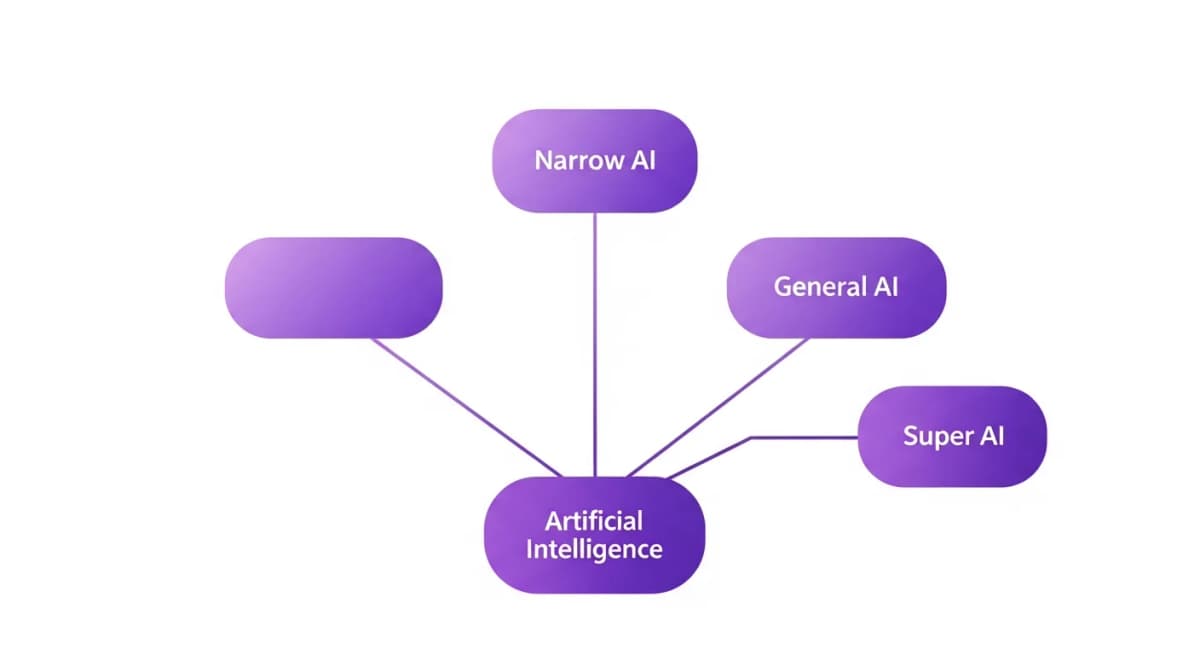
- Most business AI today is narrow AI - specialised systems that excel at specific tasks like reporting and analysis
- Generative AI (ChatGPT, Claude) creates content, while analytical AI (Alexia.ai) analyses data and generates insights
- Business leaders don't need to understand AI architecture - they need to understand which AI solves their problems
- The most valuable business AI combines multiple types: natural language processing, data analysis, and predictive analytics
Why Business Leaders Should Understand AI Types
You don't need a computer science degree to use AI effectively in business. But understanding the basic types of AI helps you evaluate tools, set realistic expectations, and identify the best opportunities for your organisation.
Think of it like understanding the difference between a sedan, an SUV, and a truck. You don't need to know how the engine works - you just need to know which one fits your needs.
Narrow AI (What You're Actually Using)
Narrow AI - also called weak AI or applied AI - is designed to excel at specific tasks. Every AI tool you currently use in business is narrow AI.
Examples in business: - Alexia.ai analysing your business data and generating reports - Gmail's spam filter classifying emails - HubSpot's lead scoring predicting which leads will convert - Google Analytics identifying traffic patterns - Fraud detection systems flagging suspicious transactions
Narrow AI is incredibly powerful within its domain. An AI reporting tool can analyse millions of data points in seconds - something no human team could do. But it can't suddenly decide to write poetry or drive a car.
For business leaders: Narrow AI is your primary concern. When evaluating AI tools, you're evaluating how well they perform their specific task.
Generative AI (Content and Conversation)
Generative AI - like ChatGPT, Claude, and Midjourney - creates new content: text, images, code, and more. This is the type of AI that's captured public attention.
Business applications: - Writing marketing copy, emails, and documents - Brainstorming ideas and strategies - Creating visual content and designs - Generating code and technical documentation - Summarising long documents and meetings
Generative AI is extraordinarily useful for content creation and communication. However, it's different from analytical AI - it creates content but doesn't connect to your business data or generate data-driven reports.
For business leaders: Generative AI is a powerful productivity tool. Pair it with analytical AI tools for a complete solution.
Analytical AI (Data Intelligence)
Analytical AI specialises in processing, analysing, and interpreting data. This is the type of AI that powers business intelligence platforms like Alexia.ai.
Business applications: - Cross-platform data analysis and reporting - KPI monitoring and anomaly detection - Trend identification and forecasting - Pattern recognition across large datasets - Real-time performance monitoring
Analytical AI combines natural language processing (understanding your questions) with data analysis (finding the answers) to deliver business intelligence through conversation.
For business leaders: Analytical AI is where the biggest operational ROI typically lives. It automates the most time-consuming business activity - data collection and reporting.
Stop reading about AI reporting. Start using it.
See how Alexia.ai automates the exact workflows covered in this article.
Predictive AI (Forecasting and Planning)
Predictive AI uses historical data and current trends to forecast future outcomes. It's a subset of analytical AI that focuses specifically on forward-looking insights.
Business applications: - Revenue and demand forecasting - Customer churn prediction - Inventory planning - Resource capacity planning - Risk assessment
Predictive AI is particularly valuable for strategic planning. Instead of relying on gut feeling or simple trend lines, businesses can make data-backed predictions about future performance.
For business leaders: Predictive AI is most valuable when built on top of good analytical AI. You need to understand your current performance before you can predict future performance.
Choosing the Right AI for Your Business
Most businesses benefit from a combination of AI types:
1. Analytical AI (like Alexia.ai) for business intelligence, reporting, and data-driven insights - this should be your foundation 2. Generative AI (like ChatGPT) for content creation, communication, and general productivity 3. Predictive AI for forecasting and strategic planning - often included in analytical AI platforms
Start with analytical AI. It addresses the biggest universal pain point (manual reporting and data analysis) and provides the data foundation for everything else.
Alexia.ai combines analytical AI, natural language processing, and predictive capabilities in one platform - connecting to your business tools and delivering intelligence through conversation.

About the Author
Simon Jones
Co-Founder, Teamified
Simon Jones is the co-founder and CTO of Teamified, bringing decades of experience in technology, system architecture, and business transformation. He oversees the technical direction of Alexia.ai, ensuring the platform delivers enterprise-grade automation and intelligence.
Connect on LinkedInExperience analytical AI for business
Get started free and see how Alexia.ai turns your business data into actionable intelligence.