

Key Takeaways
- Big data analytics no longer requires data warehouses, ETL pipelines, or teams of data scientists
- AI-powered analytics tools connect directly to business platforms and make data accessible through conversation
- The biggest analytics challenge isn't collecting data - it's making data from different sources work together
- Modern platforms like Alexia.ai democratise big data analytics so anyone on the team can get insights
The Big Data Accessibility Problem
Big data promised to revolutionise business decision-making. And for companies with dedicated data teams, it has. But for the vast majority of businesses, big data remains inaccessible.
The traditional big data stack - data warehouses, ETL pipelines, SQL queries, visualisation tools - requires specialised skills that most business teams don't have. The result is that most businesses are drowning in data but starving for insights.
Traditional Big Data Tools
Data Warehouses (Snowflake, BigQuery, Redshift) - Centralised storage for large datasets. Powerful but expensive and require dedicated data engineers.
ETL Tools (Fivetran, Stitch, Airbyte) - Move data from source systems to the warehouse. Essential for traditional analytics but add cost and complexity.
BI Platforms (Tableau, Power BI, Looker) - Visualise and analyse warehouse data. Flexible but require technical skills to create and maintain dashboards.
SQL and Python - The core tools for data analysis. Extremely powerful but limited to people with coding skills.
This stack can cost $50,000–500,000+ per year and requires dedicated data professionals to maintain.
The AI Alternative to Traditional Analytics
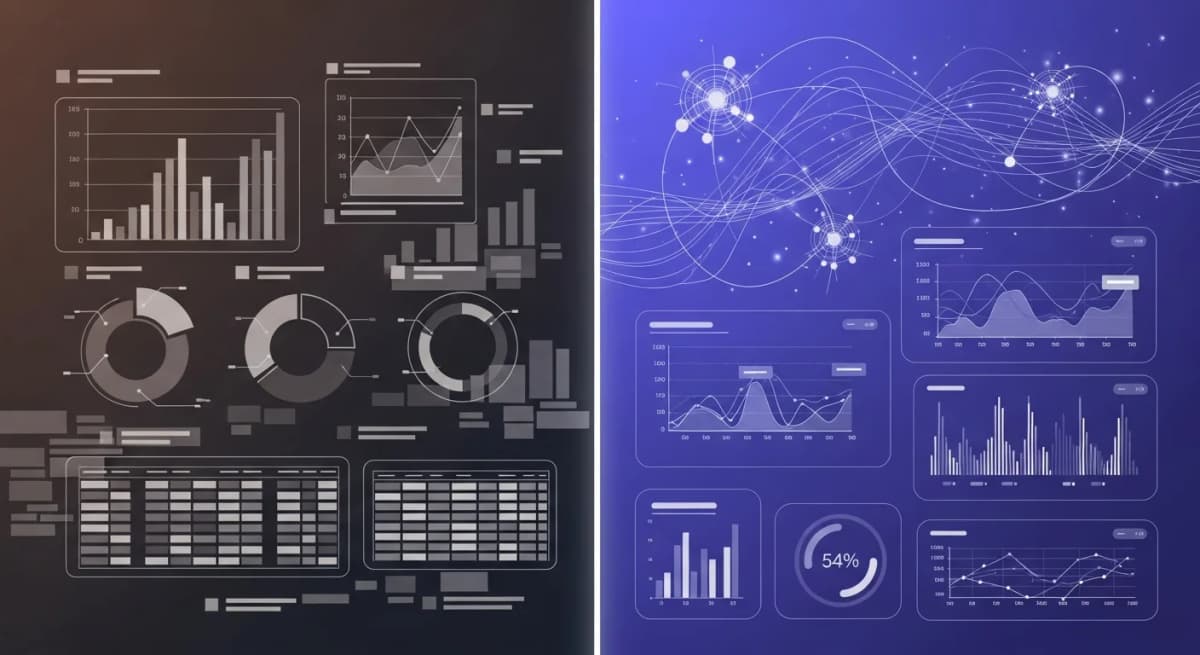
AI-powered analytics platforms offer a fundamentally different approach. Instead of building a data warehouse and writing queries, you simply connect your business tools and ask questions.
No data warehouse needed - AI connects directly to your source systems via API.
No ETL pipelines - Data is accessed in real-time, not batch-processed overnight.
No SQL required - Ask questions in natural language and get structured answers.
No dashboards to maintain - Every question gets a fresh, contextual answer rather than a static chart.
This approach makes big data analytics accessible to anyone in the organisation, not just technical specialists.
Stop reading about AI reporting. Start using it.
See how Alexia.ai automates the exact workflows covered in this article.
When to Choose Which Approach
Choose traditional big data tools when: - You have dedicated data engineers and analysts - You need to process terabytes of raw data - Your use case requires complex statistical modelling - You're building ML models from scratch
Choose AI-powered analytics when: - Your team is non-technical or has limited data resources - Your data lives in standard business tools (CRM, analytics, accounting) - You need fast answers to business questions, not raw data exploration - Speed and ease of use matter more than infinite customisation - You want cross-platform insights without building data pipelines
For most businesses, AI-powered analytics delivers 90% of the value at 10% of the cost and complexity.
Making Your Data Work Harder
The biggest opportunity in business analytics isn't collecting more data - it's making the data you already have work together.
Your Google Analytics data becomes 10x more valuable when combined with your CRM data. Your CRM data becomes 10x more valuable when combined with your financial data. The connections between datasets are where the real insights live.
Alexia.ai is built for exactly this. By connecting to 180+ business platforms, it creates a unified data layer that reveals insights no single platform could provide. And it does this in minutes, not months.
Big data analytics doesn't have to be big, expensive, or complicated. It just has to be connected.

About the Author
Simon Jones
Co-Founder, Teamified
Simon Jones is the co-founder and CTO of Teamified, bringing decades of experience in technology, system architecture, and business transformation. He oversees the technical direction of Alexia.ai, ensuring the platform delivers enterprise-grade automation and intelligence.
Connect on LinkedInUnlock your business data
Connect your tools to Alexia.ai and turn scattered data into actionable intelligence.